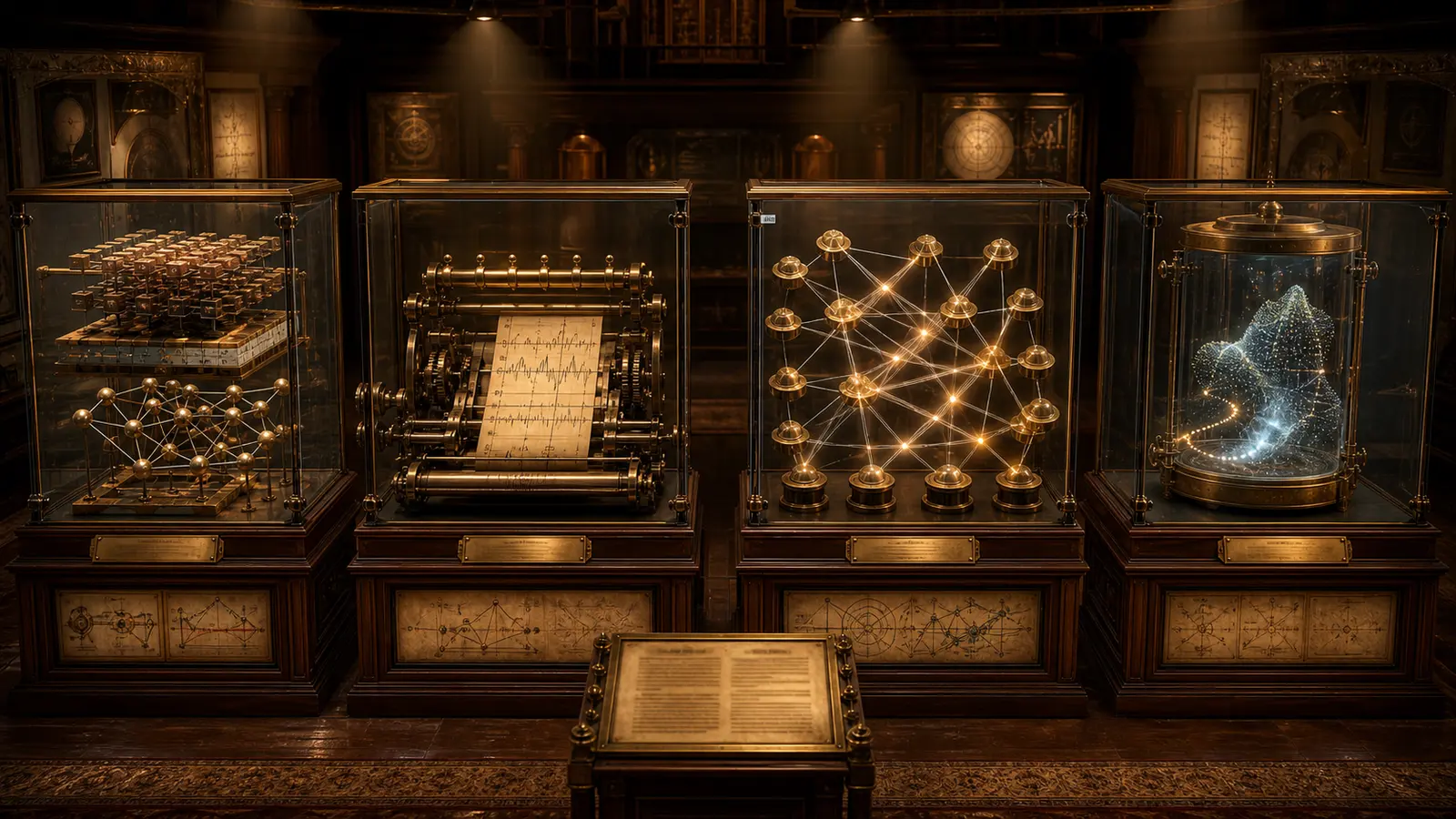
Real neural systems are hybrids. A clean taxonomy is still useful because it gives you the words to describe the mixture.
Stable Diffusion
Stable Diffusion is best understood as a latent diffusion generative system.
It uses a compressed latent space, a denoising process, spatial backbones, and text conditioning. Diffusion is the generative process; the denoising network is the backbone. Cross-attention is a mechanism inside the system, not the whole architecture.
Whisper
Whisper is an attention-heavy speech system.
Audio becomes features, those features are encoded, and a decoder emits text tokens. The system combines signal processing, sequence modeling, and encoder-decoder attention.
AlphaFold 2
AlphaFold 2 is not just "a protein model." It combines MSA and pair representations, Evoformer attention, triangle-style pair updates, and a structure module that performs geometric structure prediction.
It is a good example of why use-case labels are weak. The architecture matters because the model must reason over relationships, not just classify a biological sequence.
Sora-Style Video Models
Public descriptions of modern video generation systems often point toward diffusion-style generation with Transformer-heavy backbones over visual or latent patches.
That means the system spans generative objectives, temporal structure, spatial representation, and attention across space and time.
Mixtral-Style MoE
Mixtral-style systems show the architecture-versus-mechanism distinction clearly.
The backbone is Transformer-like. MoE changes how feedforward capacity is allocated. It is a scaling and routing mechanism inside the broader architecture.
The Practical Rule
When a system is hybrid, do not force it into one box. Describe it in layers:
- the objective,
- the backbone,
- the conditioning path,
- the routing and stability mechanisms,
- the output format.
That description is usually more useful than a single label.