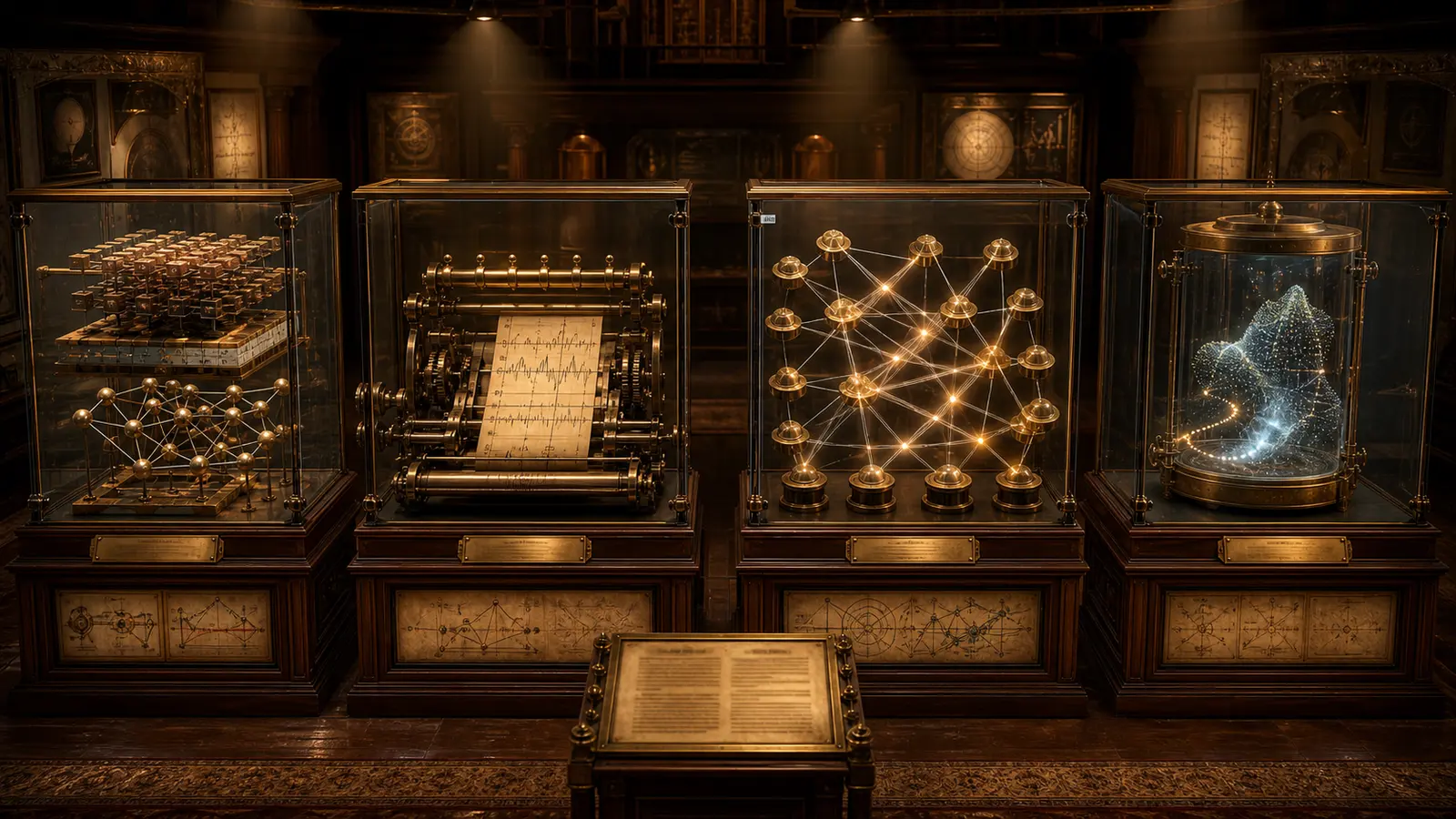
Spatial and structured architectures are the oldest part of the modern map, but they are not obsolete. They are what you reach for when the problem has stable structure and the model should exploit that structure instead of rediscovering it from scratch.
The Core Bet
The core bet is simple: useful representations can be built by applying transformations over features, neighborhoods, grids, or parts.
An MLP treats the input as a vector and is the simple feedforward case. A CNN treats nearby pixels or cells as meaningful. A ResNet makes very deep spatial processing trainable by preserving signal through skip paths. A U-Net preserves spatial detail while building high-level context. A GNN passes messages over graph edges rather than image pixels, so it belongs here as structured message passing rather than plain feedforward computation.
They look different, but they share a family resemblance: information moves through fixed or explicit structure rather than unconstrained dynamic all-to-all attention.
When This Family Fits
Use this branch when the input already has local or relational shape.
Images, segmentation masks, sensor grids, tabular vectors, molecular graphs, scene graphs, meshes, and structured neighborhoods all fit this pattern. The more stable the structure is, the more valuable the inductive bias becomes.
CNNs and U-Nets are strong when locality matters. GNNs are strong when edges and neighborhoods matter. MLPs are still useful when the representation is already compact and the task mostly needs nonlinear mixing.
What To Watch
Spatial models can be efficient and data-friendly, but they can also be too rigid. A convolution does not naturally reason across far-away parts unless the architecture gives it enough depth, pooling, or global context. A GNN can become expensive or noisy when the graph is dense or poorly defined.
The practical question is not whether attention is newer. The question is whether the problem needs flexible interaction, or whether stable structure already tells the model where to look.
Where It Connects
This family often becomes the backbone inside larger systems. Diffusion U-Nets, vision encoders, graph reasoning modules, and convolutional audio front ends all use spatial processing as one part of a hybrid model.
That is the right way to think about it: spatial architecture is a tool for structured representation, not a historical footnote.