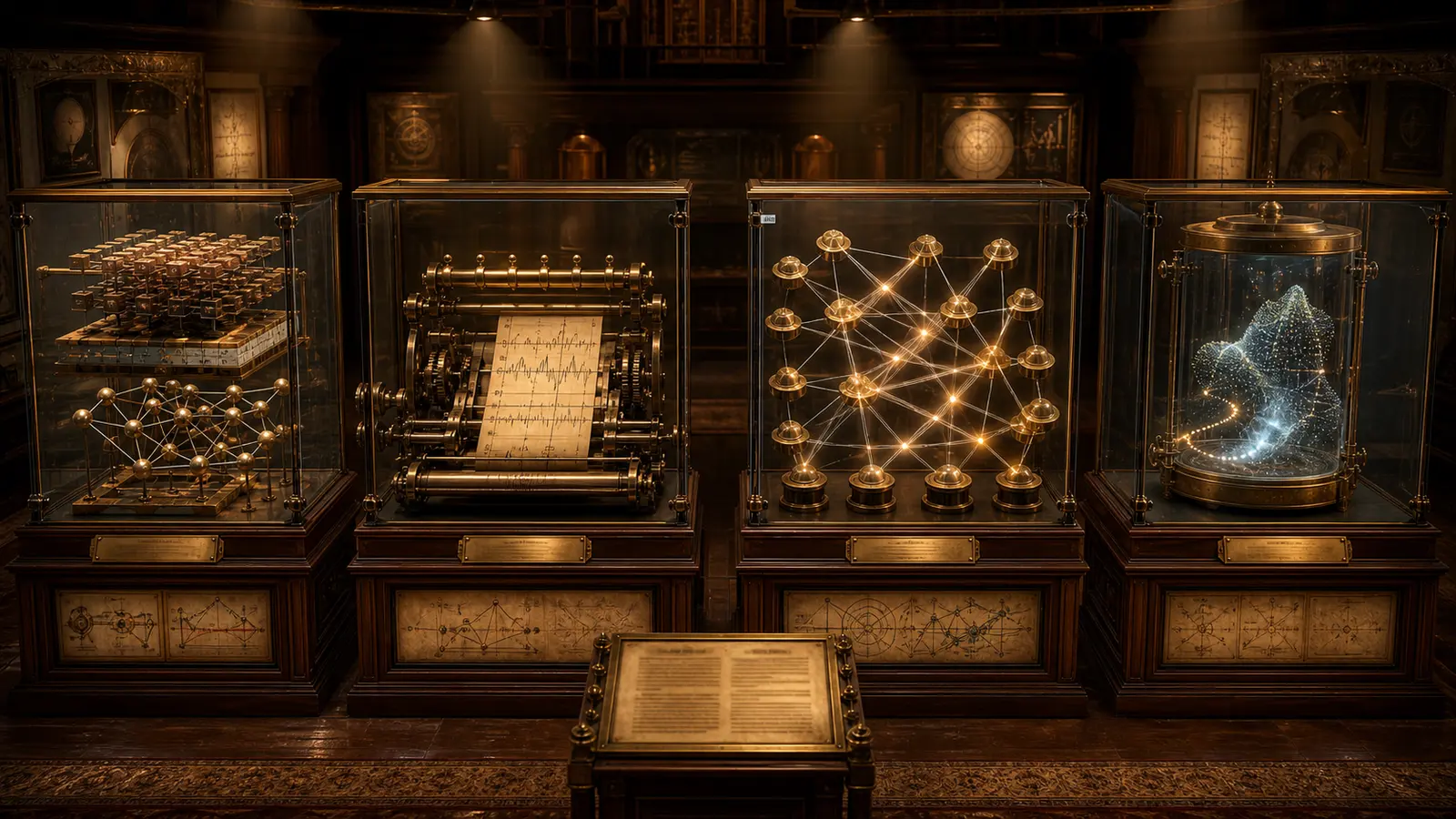
Generative and latent systems are different from classifiers and embedders because the output is not just a label or score. The model must learn enough about a distribution to produce, reconstruct, transform, or edit samples.
The Core Bet
This family assumes the model should learn a data distribution, often through a compressed or structured latent space. It mixes architecture, objective, and sampling process more than the other branches do.
VAEs learn latent variables and reconstruction. GANs train a generator against a discriminator. Diffusion models learn iterative denoising, but the denoising backbone can be a U-Net, Transformer, or another architecture. Flow matching learns transformations between distributions. Autoregressive generators factor output into a sequence of conditional predictions.
These are not just implementation styles. They define how the system learns to model and sample from a distribution.
When This Family Fits
Use this branch when the task requires production, not only prediction.
Image synthesis, audio generation, video generation, denoising, style transfer, compression, reconstruction, simulation, and data augmentation all belong here. The central question is what kind of sample should exist at the end.
What To Watch
Generative systems move the bottleneck.
Sampling speed, controllability, fidelity, diversity, safety, and evaluation become first-class concerns. A model can produce impressive examples and still be hard to steer, expensive to sample, or difficult to evaluate objectively.
Latent-space systems can reduce cost, but they add questions about what the latent representation preserves and what it throws away.
Where It Connects
Modern generative systems are rarely pure. Stable Diffusion combines latent compression, denoising, spatial backbones, text conditioning, and cross-attention. Video systems combine generative objectives with temporal and attention-heavy reasoning.
This branch is the right home for models where the output is a sample from a learned world, not a simple decision.