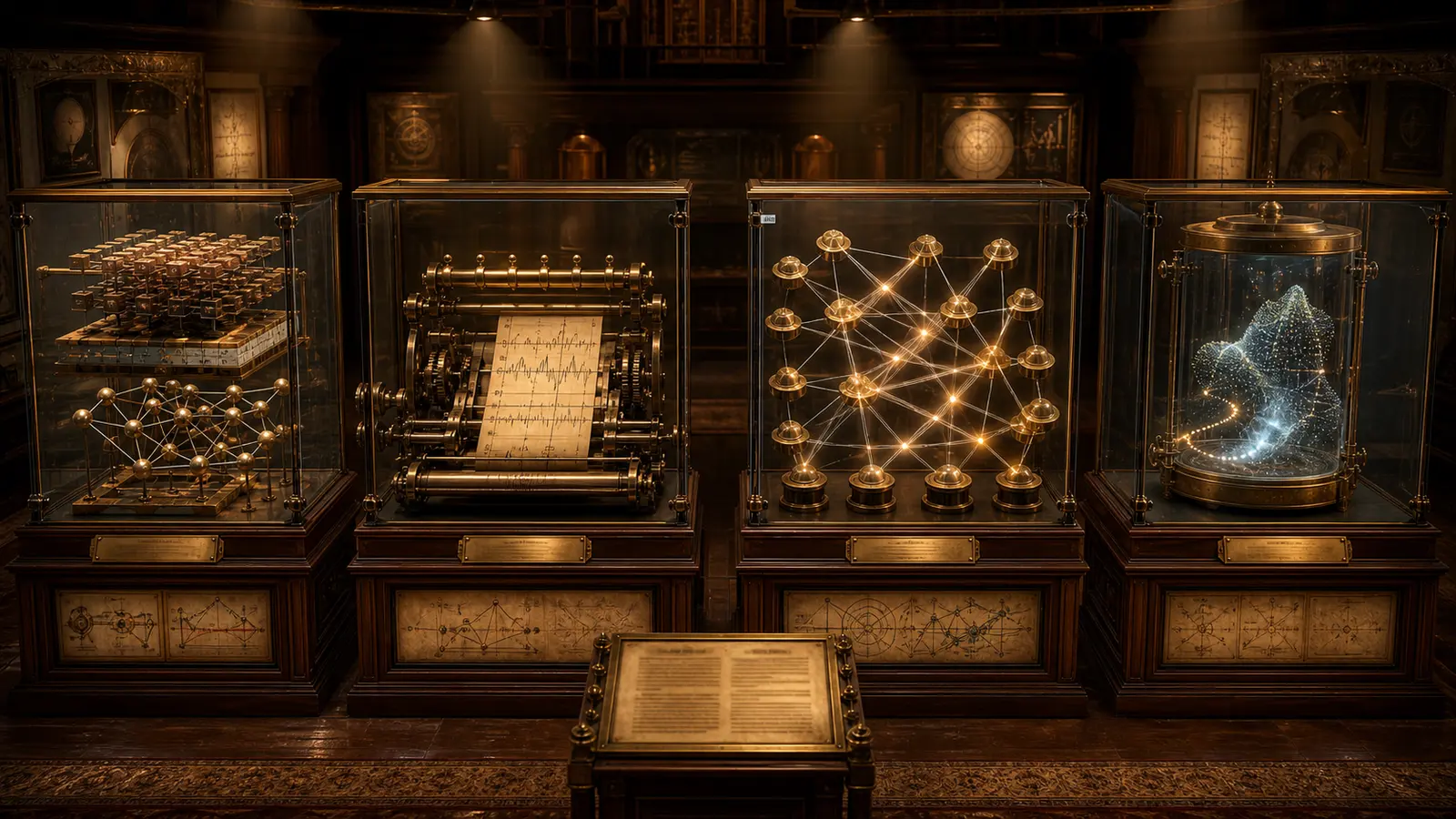
The fastest way to get confused about neural architectures is to put mechanisms and architectures in the same bucket.
They are both important. They are not the same thing.
Architecture vs. Mechanism
An architecture defines the dominant computation pattern. Convolution, recurrence, attention, graph message passing, latent denoising, and autoregressive generation are architecture-level choices.
A mechanism modifies routing, conditioning, stability, memory, scaling, or position inside an architecture.
Cross-attention, mixture-of-experts routing, positional encodings, residual paths, normalization, and gating are mechanisms. They can appear inside multiple architecture families.
Examples
Cross-attention lets one representation condition another. It can appear in translation, diffusion, multimodal assistants, and retrieval-augmented systems.
MoE routing allocates tokens or examples to selected expert subnetworks. In many public systems, the surrounding architecture is still Transformer-based.
Positional encoding gives a model access to order, location, or geometry. It does not define the architecture by itself.
Residual paths and normalization stabilize deep computation. They are critical, but they are not a family. They are engineering mechanisms that make families trainable.
Why The Distinction Matters
The distinction changes how you debug and evaluate models.
If a system is slow, the bottleneck might be attention length, expert routing, memory bandwidth, sampling steps, or graph density. If the model fails to condition correctly, cross-attention may be the issue even if the backbone is sound. If training is unstable, residual, normalization, and gating choices may matter more than the headline architecture.
Clean vocabulary gives you clean diagnosis.
How To Read A Model Description
Ask three questions.
- What is the backbone computation pattern?
- Which mechanisms modify routing, conditioning, or stability?
- Which objective teaches the model what to do?
That usually gives a better description than the model's marketing name.